
Voters Portal
Use the national voter service entry point when the state page directs you to online search, forms, or voter services.
Official
Online
If you are searching for 2002 voter list download PDF, the goal is usually not a random file. Most users need an old electoral roll record to compare name, house number, relative name, polling part, or family linkage before they fill a SIR form. This guide explains where to start, what to verify, and when a state CEO portal or Voters Portal is safer than a third-party PDF mirror.
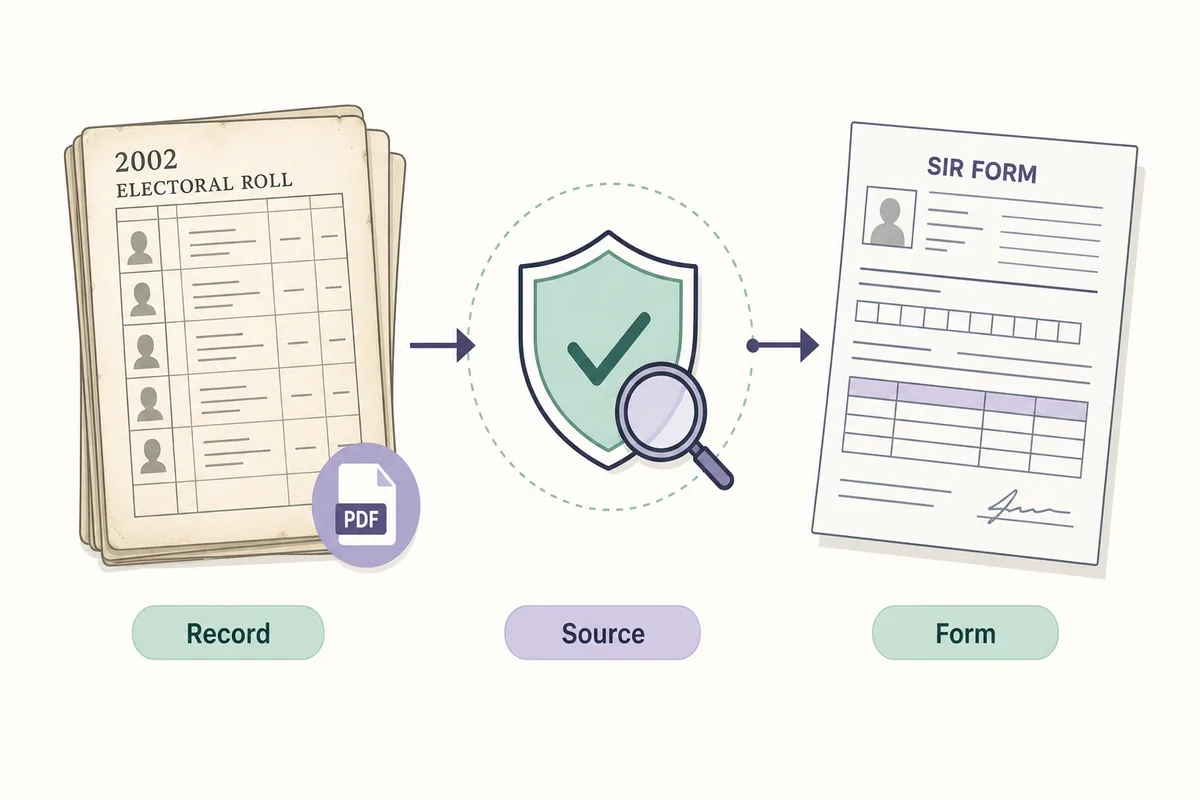
A 2002 electoral roll PDF can be useful, but only if it comes from a reliable election source and matches the correct state, district, assembly constituency, part number, and year. Start with official portals, then use this site's state guide to decide whether the old roll, SIR form PDF, or online route is the right next step.
Use the national voter service entry point when the state page directs you to online search, forms, or voter services.
Check the Election Commission of India roll guidance before trusting old electoral roll PDF copies.
Use the state guide to decide whether Delhi, Karnataka, West Bengal, Telangana, or another CEO portal is relevant.
The 2002 voter list is searched because many SIR workflows ask users to compare current household details with an older electoral roll. The useful information is usually the elector name, relative name, age at that time, house number, polling station or part number, and whether family members were listed together. That makes the old roll a reference point, not a substitute for the current SIR enumeration form.
The safest approach is to identify the exact state and assembly constituency first. A PDF from another district, a wrong year, or a copied social-media file can create mismatches that are harder to correct later. Treat any file that asks for payment, Aadhaar, OTP, or login credentials as unsafe unless it is clearly inside an official government service flow.
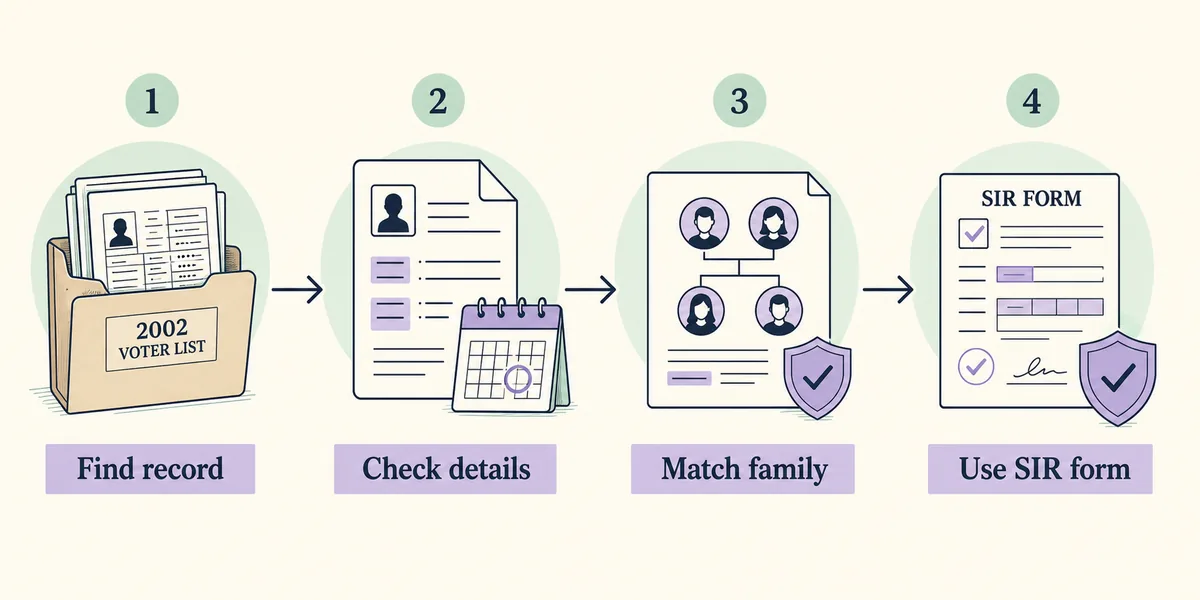
First, confirm the source domain belongs to ECI, Voters Portal, or the relevant State CEO office. Second, check that the page describes electoral rolls or SIR records, not a generic file dump. Third, match the state, district, assembly constituency, polling part, and year. Fourth, compare names and relatives carefully, because old rolls can include spelling differences. Fifth, use the SIR form or online route only after the old record makes sense.
If one of those checks fails, do not force the match. Use the state CEO contact information or the official portal route instead. For example, a person searching for a Karnataka old roll should not rely on a Delhi or Haryana PDF just because it appears in search results. The local election office context matters more than the filename.
Search demand is not evenly distributed. Similarweb global keyword data showed high related demand for 2002 voter list and strong phrase demand for Karnataka and Haryana old-list PDF variants, while several exact SIR PDF state seeds returned no measurable keyword rows. That means a broad old voter list guide is safer than creating thin pages for every state.
Use a state-specific page only when the user's intent is clearly local. Delhi users often need previous roll checks, Karnataka users may search old PDF wording, and Telangana users may need SIR enumeration instructions. For states without a clear local page, begin with the state-wise guide and official CEO portal rather than guessing a file URL.
A useful old electoral roll check focuses on stable identifiers and family context. Compare the name as printed, relative name, approximate age, house number, polling part, and locality. Do not assume that minor spelling differences automatically mean the record is wrong; older rolls may use abbreviations, local transliteration, or older address formats.
For SIR form preparation, write current details exactly as instructed by the current form or portal. The 2002 voter list can help you understand continuity, but current instructions still decide what must be submitted. If the old roll conflicts with current records, keep notes and verify through the official state channel.
Use a 2002 voter list PDF when you only need historical reference. Use the SIR form PDF when you need to review or print the current enumeration form. Use the online route when your state or Voters Portal asks for digital submission, verification, or status checking. Mixing those three jobs is a common cause of confusion.
If you are unsure, start from the SIR form PDF page for the current form, then open the online download guide for portal steps. Return to the old roll only when the form or official notice asks for previous roll comparison. This keeps the workflow simple and avoids sharing personal data with unofficial pages.
Voter records can include personal or household information. Do not upload old roll pages, EPIC numbers, Aadhaar numbers, phone numbers, or family documents to pages that are not clearly official. A site can look helpful while still collecting more data than it needs.
This guide does not verify voter identity and does not host an official 2002 voter list database. It is a route map for choosing safer sources. Final instructions, accepted documents, deadlines, and correction procedures should always come from ECI, Voters Portal, or the relevant State CEO office.
Use these sources to confirm current roll, form, and portal instructions. Availability changes by state and time.
Start with official election sources: ECI, Voters Portal, or the relevant State CEO website. If a search result is a copied PDF without state, constituency, part number, and year context, treat it as unverified.
No. The old voter list is a historical electoral roll reference. A SIR form is the current enumeration or verification form. Use the old roll to compare details only when the official instruction asks for it.
No. Old roll PDFs are state, district, constituency, and part specific. A high-ranking PDF for one state does not validate another state user's SIR details.
Do not assume the record is invalid immediately. Older rolls may contain abbreviations or transliteration differences. Compare relative name, locality, house number, and part number, then verify through the official state channel.
Avoid uploading sensitive identifiers to unofficial pages. Use only official portals when a form or verification step requires personal data.
Use the SIR form download PDF page for current form review, the online guide for portal steps, or the state-wise guide when local CEO instructions matter.