Election Commission of India
Use the ECI electoral-roll information page to find the current national route and the state service named by an active notice.
Official reference
State route may vary
The SIR full form in election is Special Intensive Revision. In India, it describes an intensive review of electoral rolls so the responsible election authorities can verify entries, publish a draft roll, receive claims or objections, and prepare a final roll for the relevant revision. SIR is a process, not a voter ID, a single PDF, a private status checker, or proof that a person's name is included. This guide explains the term first, then separates the public process from the forms and services people often confuse with it.
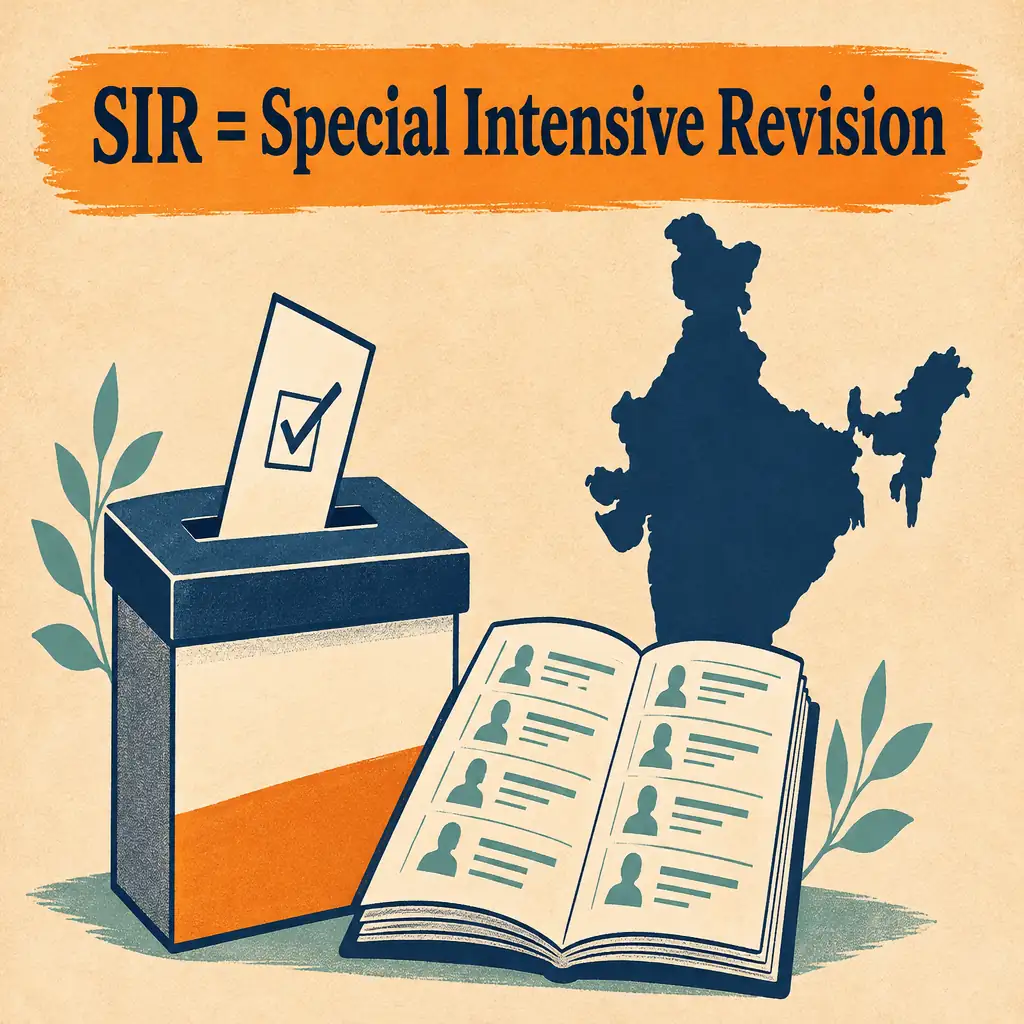
The word SIR can appear beside a state schedule, enumeration form, draft roll, or search service. Open the authority's current page for dates and instructions. This guide explains the language and decision path but does not host a roll or promise a permanent PDF.
Use the ECI electoral-roll information page to find the current national route and the state service named by an active notice.
The official FAQ is a useful reference for the full form, the revision stages, and the distinction between a process and a personal record.
A state or district government page shows why schedules, draft-roll dates, and claim windows must be checked for the relevant area.
SIR stands for Special Intensive Revision. In an election context, it is a structured review of electoral-roll entries. The responsible authorities use the revision to check the roll, identify records that need clarification, publish a draft stage, allow the prescribed claims or objections, and issue the final roll for the applicable schedule. The exact forms, dates, portals, and supporting documents depend on the notice for the state or revision round.
That definition answers the common search, but it does not answer every personal question. SIR is not the name of a downloadable identity card, a universal application number, or a website owned by this guide. A person can read a SIR notice without being able to confirm a private record. To check a name, submit a form, or ask for a correction, use the official service that the current ECI or State CEO notice identifies.
A revision can involve checking entries, matching information requested by the authority, preparing an enumeration stage, publishing a draft roll, and processing claims or objections. Those stages are administrative steps. They should not be collapsed into the claim that every name has been removed, every form has been accepted, or every old record is automatically valid. Read the notice for the qualifying date, area, roll edition, and response route.
A SIR reference also does not prove current registration. A historical 2002 voter-list entry, a submitted enumeration form, a Form 6 application, and a name in a draft roll answer different questions. Treat each result as evidence for its own task. If a page asks for an EPIC number, Aadhaar detail, phone number, document, or one-time password, enter it only on a verified government domain and only when the current instructions require it.
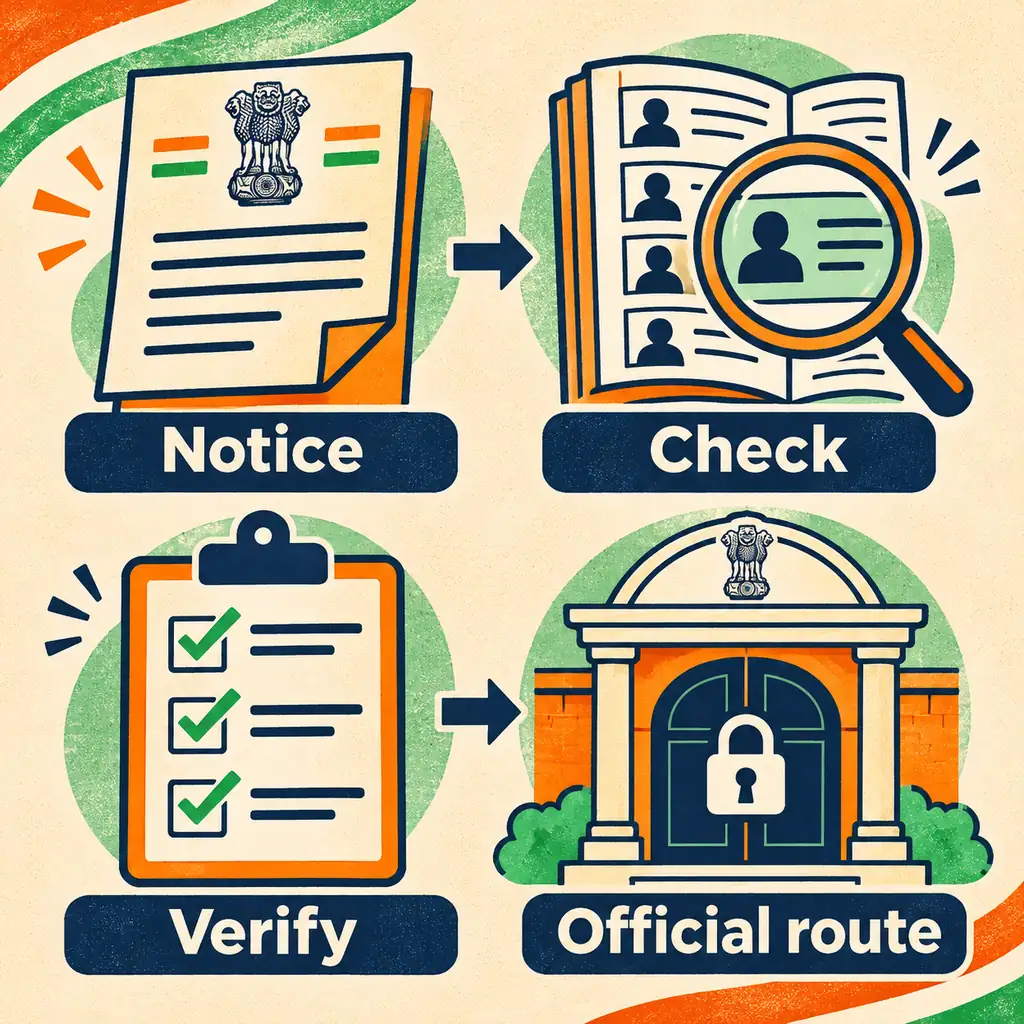
The sequence is easier to understand when each public step has a separate purpose. An authority publishes a notice or schedule, explains the area and qualifying date, and tells electors where to find the relevant service. Enumeration or verification then collects the information required for that revision. After the draft roll is published, the notice normally explains how to submit a claim, objection, correction, or supporting document. The authority reviews those responses before publishing the final roll or a revised outcome.
Schedules are not interchangeable across India. A state page may show a draft publication date, a claims window, a disposal date, or a final-roll date that differs from another state or district. Search results can also retain an older date. When a result conflicts with the current notice, use the current official page and save the notice date privately for your own reference.
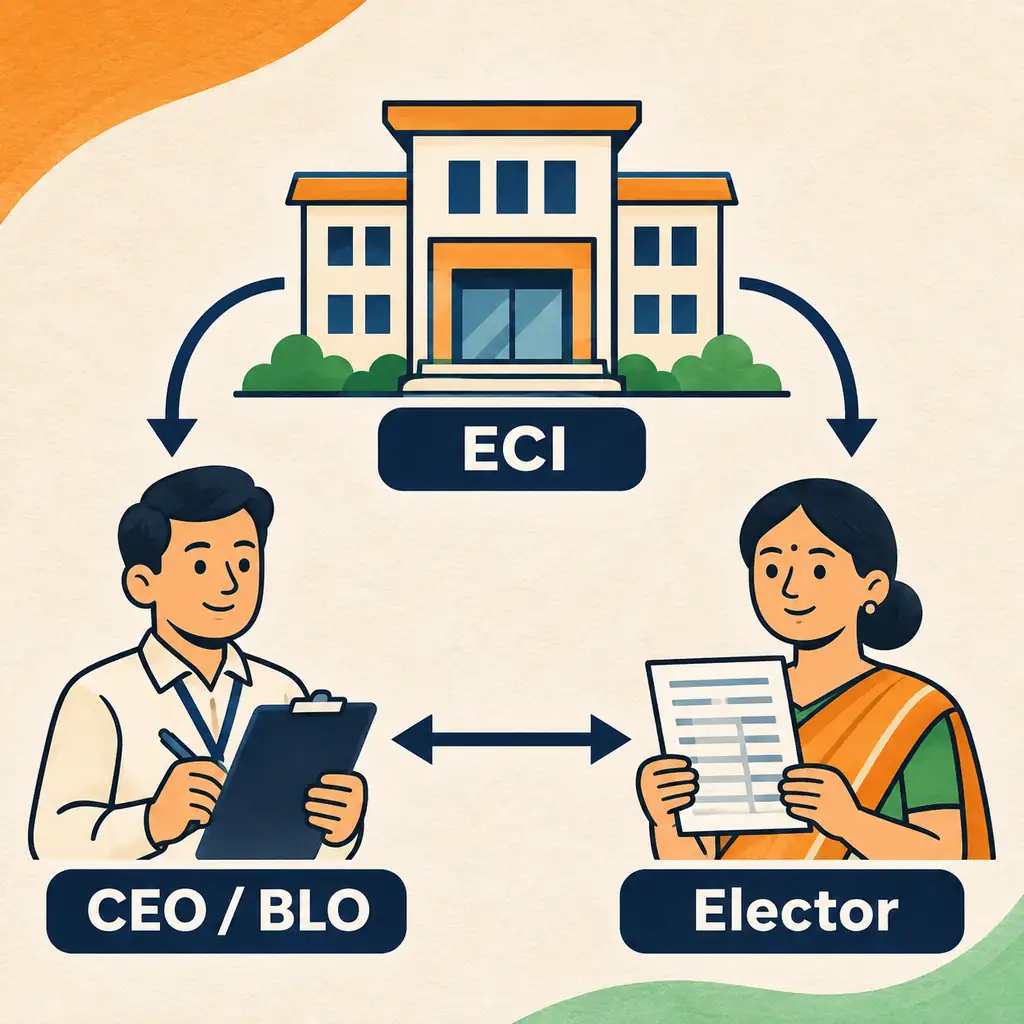
The Election Commission of India sets national election administration directions and publishes central information. A State Chief Electoral Officer provides state-level notices, schedules, links, and help routes. A Booth Level Officer, or BLO, may support local enumeration or verification according to the active instructions. The elector checks the notice, supplies information through the approved channel, reviews the draft result when available, and uses the stated claims or correction process when something is wrong.
These roles explain why a third-party guide cannot confirm a person's record. A page can point to the right kind of authority and explain the vocabulary, but it cannot replace the official database or the officer assigned to the area. If a portal is unavailable, use the help details on the official notice rather than sending personal documents to a social account or an unverified download page.
The easiest way to avoid a wrong download is to match the task to the service. SIR names the revision exercise. Form 6 is commonly associated with an application for inclusion or new registration, while Forms 7 and 8 are used for other elector requests under the applicable rules. A status check follows a submitted request. A voter-list search checks a roll edition. The exact workflow and labels can change, so the current official notice remains the final authority.
This distinction matters for searchers who see the words SIR, form, and voter list on the same page. Do not use a Form 6 page as proof that your name is in a draft roll, and do not treat a status message as a final-roll result. Use the guide that matches your task, then follow the official link it identifies.
Start with the ECI or State CEO domain named by the notice. Confirm the state, district or constituency, revision year, qualifying date, and service name before entering anything. If a PDF is offered, open it from the authority page and check the visible title, issuing authority, edition, and date. A filename or search snippet alone is not enough to call a document official.
Keep personal information private. This site does not ask for EPIC, Aadhaar, address, phone number, document uploads, or OTP. If a name is missing, recheck the selected area, spelling, part, and edition, then follow the official claims, objections, correction, or help route. A missing result can reflect a wrong field, an unavailable service, a boundary change, or a revision stage; it is not a conclusion by itself.
This page explains the meaning of SIR, the usual relationship between notice, verification, draft roll, claims, and final roll, and the difference between the process and nearby services. It does not access electoral records, decide eligibility, reproduce a state schedule, or guarantee that a particular PDF remains online. Dates and portal menus can change after publication, so use the linked authority for a time-sensitive decision.
The sources below were checked on 7 November 2026. The Pune government SIR page responded to the validation request. The ECI information page returned HTTP 406 and the CEO Delhi FAQ PDF was not reachable from this environment, so those links are kept as official reference destinations rather than claims of a live download.
These links support the explanation. They do not make this independent guide an official election service, and a page or PDF can move after the source check.
SIR means Special Intensive Revision. It is a structured review of electoral rolls in which the authority may verify entries, publish a draft roll, receive claims or objections, and prepare a final roll for the applicable schedule.
No. SIR is the revision exercise. A PDF may be a notice, form, draft roll, or another document published by an authority, but the file format does not define SIR and a copied PDF is not automatically official.
No. A form receipt or status message concerns a submission. A voter-list search concerns a particular roll edition, area, and revision stage. Use the official service that matches the question.
Start with the current ECI or State CEO notice and use the help route it names. A BLO or local election office may be relevant when the notice assigns local support. Do not send personal documents to this site.
Not necessarily. A state, district, or revision round can publish its own qualifying date, draft-roll date, claims window, and final-roll schedule. Check the authority for the area in question instead of reusing a date from a search snippet.
A historical 2002 list can be requested or referenced in some workflows, but it remains a historical record. It does not automatically confirm a current entry or replace the active SIR notice.
No. This guide does not access voter records and does not need EPIC, Aadhaar, address, phone, document, or OTP details. Use personal information only on a verified official service when its current instructions require it.